Most of us were taught to learn by repeating information. But true mastery comes from ascending a ladder of cognitive skills, from simple recall to the art of thinking about thinking.
Summary
Our educational system often rewards the lowest level of thought: memorization. We spend hours rereading notes and making flashcards, only to find the knowledge is fleeting. This approach mistakes the collection of information for the transformation of thought. A more powerful model for intellectual development is a hierarchy of cognitive skills, closely based on the well-established framework of Bloom's Taxonomy. This model outlines seven levels of thinking, starting with basic recall and ascending to more complex skills like analysis, evaluation, and creation. The ultimate stage is reflection, or metacognition—the ability to consciously observe and refine one's own thinking process. By understanding and intentionally practicing these levels, we can move from being passive consumers of information to active authors of our own understanding. This isn't a study hack; it's a roadmap to mastering the art of reasoning and achieving genuine intellectual growth.
Key Takeaways; TLDR;
- True learning isn't about memorizing facts, but about transforming how you think.
- The 'seven levels of thought' are a practical framework based on Bloom's Taxonomy, a cornerstone of educational psychology.
- Lower-level skills like 'Remembering' and 'Understanding' are foundational but insufficient for mastery.
- Higher-level skills involve 'Applying' knowledge, 'Analyzing' its components, 'Evaluating' its worth, and 'Creating' new ideas.
- The highest level, 'Reflection' (Metacognition), is the ability to think about your own thinking, which allows you to consciously control and improve your learning process.
- Effective learning strategies like retrieval practice are far superior to passive rereading for building durable knowledge.
- Moving up the levels requires shifting from a passive, obedient mindset to an active, curious one that questions, connects, and experiments with ideas.
- While the hierarchy is a useful model, real-world thinking is often not strictly linear; different cognitive skills can interact in complex ways.
- Mastering this framework enables you to become a self-regulated learner, capable of tackling complex problems and generating original insights.
The Illusion of Learning
Most of us were taught that learning is the act of collecting information. We spent years highlighting textbooks, rereading notes, and cramming for exams, operating under the assumption that effort equals progress. Yet, how often does that hard-won knowledge evaporate just days later? This is the illusion of learning: the comforting feeling of familiarity that we mistake for genuine comprehension.
Many educational systems, often constrained by standardized testing, implicitly guide students toward the lowest levels of thought: memorization and repetition . We become adept at echoing information but remain novices in the art of thinking. True learning, however, is not about filling a vessel but kindling a fire. It’s a transformation in how we think.
There is a hidden structure to intellectual development, a map of the mind that can guide us from being passive recipients of facts to active architects of understanding. This structure is a hierarchy of cognitive skills, a framework that has been a cornerstone of educational psychology for over half a century . By ascending its levels, we can learn to master our own minds.

True learning is a journey upward through distinct stages of cognitive skill.
A Proven Framework for Thought
The concept of a cognitive hierarchy was most famously articulated by educational psychologist Benjamin Bloom in 1956 and revised in 2001 by his student Lorin Anderson and colleague David Krathwohl [12, 27]. Known as Bloom's Taxonomy, it classifies cognitive skills into six ascending levels of complexity: Remembering, Understanding, Applying, Analyzing, Evaluating, and Creating [1, 29].
The seven-level model presented here is a powerful extension of that classic framework, adding a crucial seventh layer: Reflection, or metacognition. It provides a clear path from the shallow act of repeating to the profound act of mastering one's own thought processes.
Level 1 & 2: From Echo to Understanding
The journey begins where most formal education is focused, but also where many learners get stuck.
Level 1: Remembrance
This is the most basic level: recalling facts, terms, and basic concepts. Think of memorizing historical dates, vocabulary words, or mathematical formulas. The primary tools here are repetition, rereading, and flashcards. While necessary, this level is deceptive. The brain acts like a machine, copying symbols without grasping their meaning. Knowledge here is fragile, like words written in sand, easily erased by time or stress .
The danger of remembrance is the illusion of knowing . Because rereading feels productive, we believe we are learning. However, cognitive science shows that passive review is one of the least effective ways to build long-term memory .
Level 2: Understanding
This is the first real step toward learning. Understanding is about explaining ideas or concepts in your own words. It’s the “aha!” moment when disconnected facts begin to form a coherent picture. At this level, the mind stops being a repeater and starts being an interpreter. You can summarize a chapter, explain a scientific theory to a friend, or grasp the main argument of an essay.
To bridge the gap from remembrance to understanding, you must engage with the material actively. Instead of just rereading, try these evidence-based techniques:
- Retrieval Practice: Close the book and actively recall what you just read. This act of pulling information from your memory strengthens neural pathways far more effectively than passively rereading it [10, 24].
- Elaboration: Explain the concept out loud as if you were teaching it to a child. This forces your brain to form original connections and reveals gaps in your comprehension.
- Ask Questions: Don't just accept information. Ask why it's true, how it connects to what you already know, and what if the opposite were the case? A curious mind is an understanding mind.
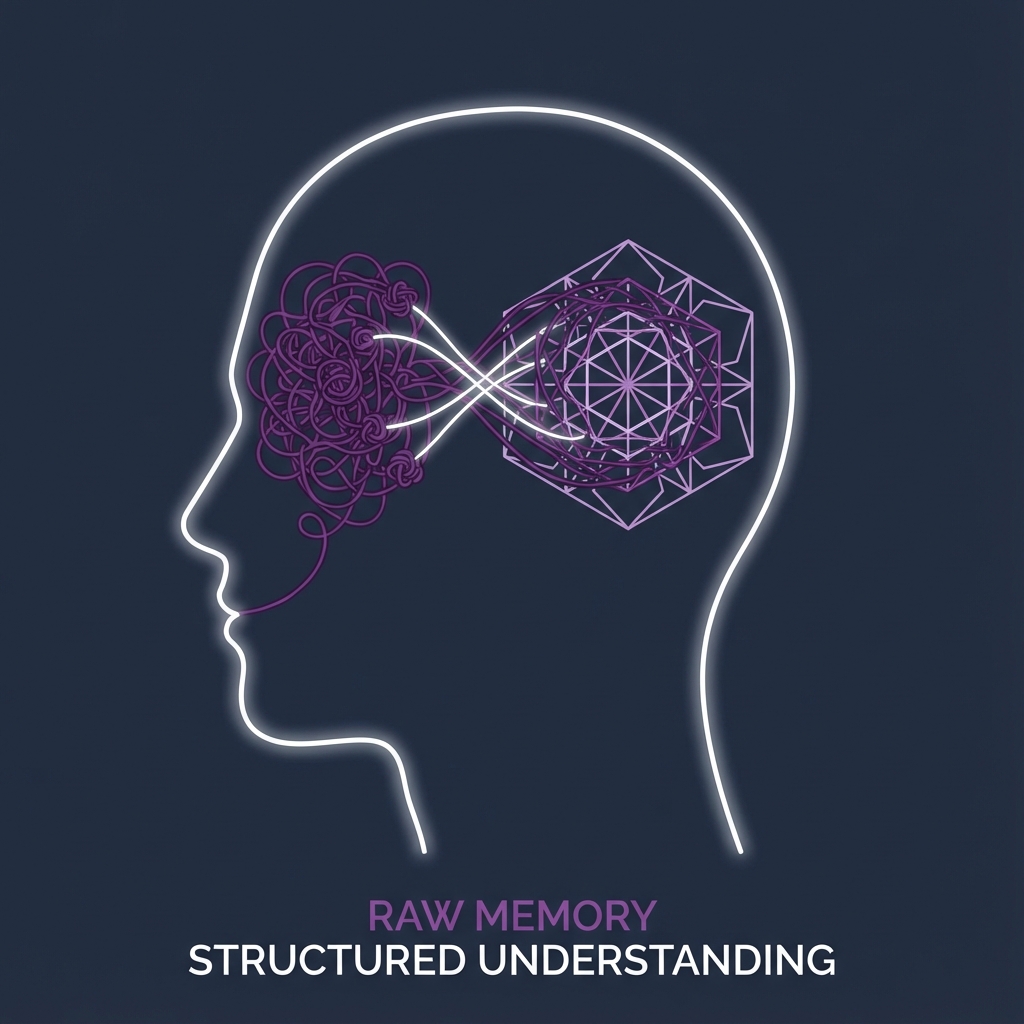
Understanding is the act of weaving disparate facts into a coherent whole.
Level 3 & 4: Putting Knowledge to Work
Once you understand an idea, the next step is to make it useful. This is where knowledge transforms from a passive possession into an active tool.
Level 3: Application
Application is the ability to use information in new situations. It’s where theory collides with reality. You can read a hundred books on swimming, but you only learn when you get in the water. This level is about executing and implementing. It means solving a physics problem with the right formula, using grammar rules to write a clear sentence, or applying a business framework to a case study.
Learning at this stage becomes concrete. The brain builds stronger, more durable connections through doing than through watching. The key is to embrace experimentation and not fear mistakes. Mistakes are not failures; they are data. Each error provides a precise map of what you haven't yet mastered.
Level 4: Analysis
Analysis is the ability to break down information into its constituent parts to explore relationships and understand its structure. While application is about using knowledge, analysis is about dissecting it. An analytical mind doesn't just see facts; it sees patterns, causes, and consequences.
This is the level where strategic thinking is born. You learn to distinguish the essential from the noise. Examples of analysis include:
- Comparing and contrasting two different philosophical arguments.
- Identifying the underlying assumptions in a news article.
- Creating a diagram showing the causal relationships in a historical event.
To develop your analytical skills, practice deconstruction. Take ideas apart to see how they work. Use contrast tables to map similarities and differences. Ask second-order questions: not just "What is this?" but "How does this relate to that?" and "What is the logic holding this system together?"
Level 5 & 6: The Architecture of Wisdom
The highest levels of the cognitive hierarchy are where true innovation and sound judgment emerge. Here, you move from working with existing knowledge to creating new knowledge and making informed decisions.
Level 5: Evaluation
Evaluation is about making judgments based on criteria and standards. It’s the ability to assess the credibility, relevance, and value of information. Knowing what to ignore is as important as knowing what to focus on. A mind that cannot prioritize drowns in information; a mind that evaluates with clarity builds wisdom.
At this level, thinking becomes critical and responsible. You defend a position, critique an argument, or decide on the most suitable course of action. This requires a delicate balance: the courage to doubt without falling into cynicism, and the humility to learn without blind submission. The goal is not to be right, but to be clear.
To strengthen your evaluative thinking, constantly ask, "Why does this matter?" Create value hierarchies for ideas: what is essential, what is useful, and what is disposable? Engage in respectful debate, focusing on the logic of arguments, not the authority of voices.

Evaluation is the art of discerning the value and components of an idea.
Level 6: Creation
At the pinnacle of the original Bloom's Taxonomy is creation: putting elements together to form a new, coherent whole . This is where knowledge becomes invention. The creative mind synthesizes information from disparate fields to generate something that did not exist before.
Creation is not a mystical gift reserved for a select few. It is the natural outcome of a mind that has mastered the preceding levels. When you understand deeply, apply broadly, analyze rigorously, and evaluate wisely, you inevitably begin to see new connections and possibilities. Examples include:
- Designing an original experiment to test a hypothesis.
- Composing a piece of music.
- Developing a new business strategy.
- Writing a compelling argument that synthesizes multiple sources.
Creativity thrives on freedom and curiosity. To cultivate it, play with what you know. Mix concepts from different domains—apply a principle from biology to an economic problem. Ask questions with no ready answers. The most innovative ideas are often born at the intersection of disciplines.
Level 7: The Final Ascent: Thinking About Thinking
Beyond creating is a final, overarching level that governs all the others. It’s the ability to turn your attention inward and observe your own mental machinery.
Level 7: Reflection (Metacognition)
Metacognition, a term coined by psychologist John Flavell in the 1970s, is simply "thinking about thinking" [6, 11]. It is the awareness and understanding of your own thought processes. If the first six levels are the software programs of the mind, metacognition is the operating system that allows you to install, update, and debug them.
At this stage, you are no longer just a student in the maze; you are the architect observing it from above. You recognize your own cognitive patterns, biases, and habits. You ask questions like:
- Why did I understand that concept easily but struggle with this one?
- What mental state helps me learn most effectively?
- What are the triggers for my procrastination or distraction?
This is the foundation of self-regulated learning, where you consciously direct your own intellectual growth [3, 25]. You stop depending on external techniques and become your own method. You analyze your learning process, treat mistakes as diagnostic tools, and design your own strategies for improvement. This reflective practice is what separates good learners from great ones.
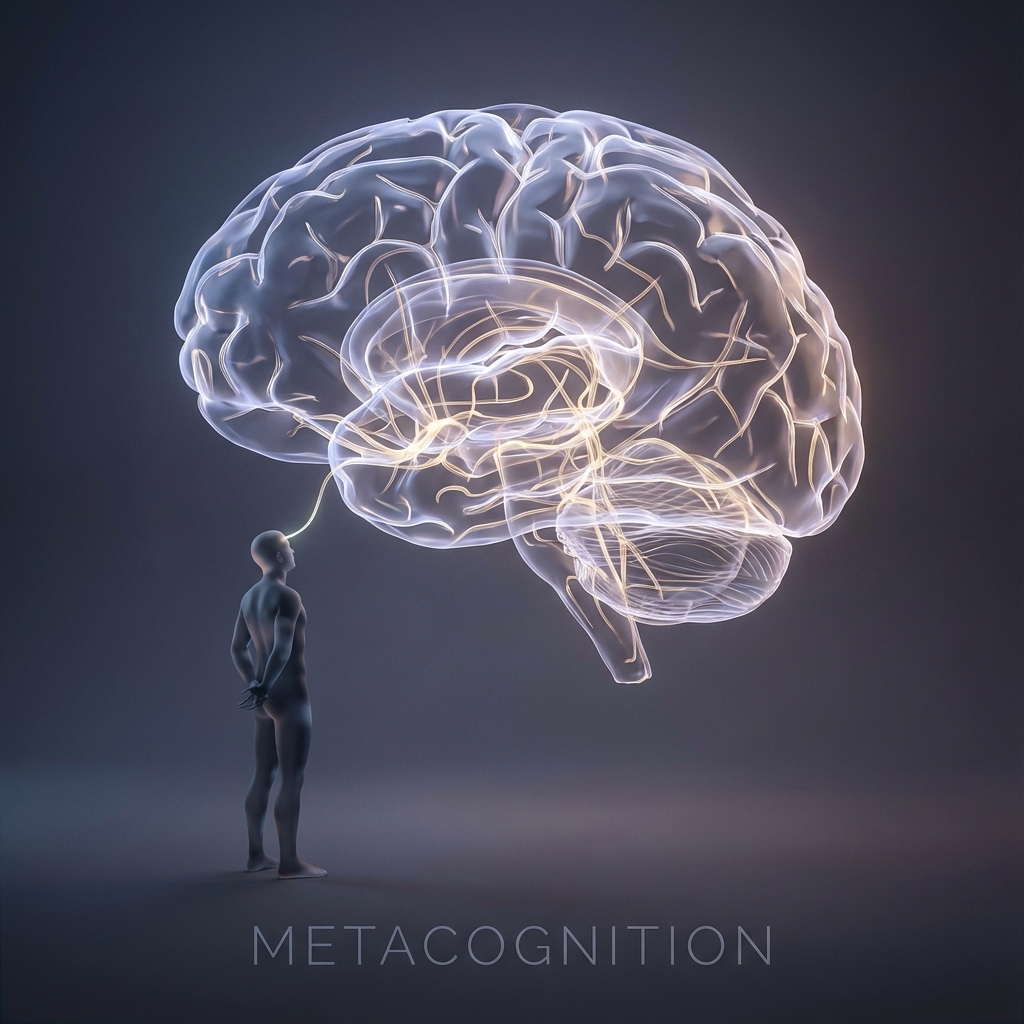
Metacognition is the ultimate level: the mind observing itself.
Why This Framework Matters
Understanding these levels of thought is more than an academic exercise. It provides a practical roadmap for anyone looking to deepen their intellect and become more effective in their work and life.
In a world saturated with information, the ability to move beyond simple recall is a critical advantage. The challenges we face—whether in science, business, or our personal lives—require not just knowledge, but the ability to apply, analyze, evaluate, and create. They demand clear judgment and innovative solutions.
By consciously practicing these higher-order skills, you can transform your relationship with knowledge. You stop being a slave to information and become the author of your own understanding. Learning ceases to be a chore and becomes the most profound act of human development: the art of becoming a better thinker.
I take on a small number of AI insights projects (think product or market research) each quarter. If you are working on something meaningful, lets talk. Subscribe or comment if this added value.
Appendices
Glossary
- Bloom's Taxonomy: A hierarchical framework for classifying educational learning objectives into levels of complexity and specificity. The revised version (2001) includes six levels: Remembering, Understanding, Applying, Analyzing, Evaluating, and Creating .
- Metacognition: Coined by John Flavell, it refers to the awareness and understanding of one's own thought processes. It is often described as 'thinking about thinking' and involves skills like planning, monitoring, and self-reflection .
- Retrieval Practice: A learning strategy that involves actively recalling information from memory, rather than passively rereading it. This 'testing effect' is proven to be more effective for building long-term, durable knowledge .
- Self-Regulated Learning (SRL): A process in which learners actively manage their own learning by setting goals, employing strategies, monitoring their progress, and reflecting on outcomes. It is heavily dependent on metacognitive skills [3, 25].
Contrarian Views
- The hierarchical structure of Bloom's Taxonomy is a simplification. Real-world thinking is not always linear; skills like creation and analysis are often intertwined and can occur in a different order [2, 30].
- Some critics argue that the taxonomy's focus on abstract cognitive skills de-emphasizes other crucial aspects of learning, such as motivation, social context, and emotion .
- An overemphasis on higher-order thinking without a strong foundation of memorized knowledge can be counterproductive. Foundational knowledge is the raw material upon which critical thinking operates [30, 37].
Limitations
- This seven-level framework is a model, not a rigid prescription. Cognitive processes are dynamic and can interact in complex ways.
- Progressing through the levels is not automatic and requires conscious, sustained effort. Many educational environments do not explicitly teach or reward higher-order thinking skills.
- Individual learning styles and contexts can affect how a person moves through these stages. What works for one person or subject may need adaptation for another.
Further Reading
- A Taxonomy for Learning, Teaching, and Assessing: A Revision of Bloom's Taxonomy - https://www.amazon.com/Taxonomy-Learning-Teaching-Assessing-Educational/dp/080131903X
- Make It Stick: The Science of Successful Learning - https://www.amazon.com/Make-Stick-Science-Successful-Learning/dp/0674729013
- Metacognition: The Gift That Keeps Giving - https://www.apa.org/education-career/k12/metacognition
References
- Bloom's Taxonomy of Learning | Domain Levels Explained - Simply Psychology (org, 2025-03-11) https://www.simplypsychology.org/blooms-taxonomy.html -> Provides a comprehensive overview of both the original 1956 Bloom's Taxonomy and the 2001 revision by Anderson and Krathwohl, explaining the shift from nouns to verbs and the elevation of 'Creating' to the highest level.
- A Critical Appraisal of Bloom's Taxonomy - American Research Journals (journal, 2020-11-01) https://www.aresearchjournals.com/wp-content/uploads/2020/11/A-Critical-Appraisal-of-Blooms-Taxonomy.pdf -> Outlines key criticisms of Bloom's Taxonomy, such as its hierarchical structure not being supported by research and the difficulty of mapping complex learning activities to a single level. Used for adding nuance.
- Self-Regulated Learning Theory - Design in Progress (org, 2024-01-01) https://designinprogress.art/self-regulated-learning-theory/ -> Explains Self-Regulated Learning (SRL) as a process of learners taking charge of their own learning through goal-setting, monitoring, and reflection, which directly supports the concept of the seventh level.
- Self-Regulated Learning: An Overview - ResearchGate (journal, 2009-01-01) https://www.researchgate.net/publication/228465173_Self-Regulated_Learning_An_Overview -> Details the components of self-regulated learning, including cognition, metacognition, and motivation, providing academic backing for the importance of the 'Reflection' level.
- The Seven Levels of Thought - YouTube (video, 2024-09-01)
-> The original source material for the article, outlining the seven-level framework for cognitive development. - Metacognition (Flavell) - Learning Theories (org, 2017-04-06) https://www.learning-theories.com/metacognition-flavell.html -> Attributes the term 'metacognition' to John H. Flavell and defines it as 'thinking about your own thinking,' including the processes of planning, tracking, and assessing one's own understanding.
- A Review of Self-regulated Learning: Six Models and Four Directions for Research - Frontiers in Psychology (journal, 2017-04-28) https://www.ncbi.nlm.nih.gov/pmc/articles/PMC5406283/ -> Provides a detailed academic review of various models of Self-Regulated Learning (SRL), reinforcing its importance as a framework for understanding the cognitive, metacognitive, and motivational aspects of learning.
- Bloom's taxonomy - Wikipedia (org, 2025-11-10) https://en.wikipedia.org/wiki/Bloom%27s_taxonomy -> Provides a general, accessible overview of the history and structure of Bloom's Taxonomy, including its three domains and the 2001 revision.
- Bloom's Taxonomy - University of Waterloo (edu, 2023-01-01) https://uwaterloo.ca/centre-for-teaching-excellence/teaching-resources/teaching-tips/planning-courses-and-assignments/course-design/blooms-taxonomy -> Explains the hierarchical nature of the taxonomy and the significance of the 2001 revision's shift from nouns to verbs, emphasizing active performance.
- Comparison of Rewatching Class Recordings versus Retrieval Practice as Post-Lecture Learning Strategies - Medical Science Educator (journal, 2022-03-01) https://www.ncbi.nlm.nih.gov/pmc/articles/PMC8913330/ -> A study showing that while rereading/rewatching may help short-term recall, retrieval practice is a more efficient use of time for similar or better long-term retention.
- Concept Of Metacognition – John Hurley Flavell - Communication Theory (org, 2023-01-01) https://www.communicationtheory.org/concept-of-metacognition-john-hurley-flavell/ -> Defines metacognition as a higher-order thinking process involving rationalization, assessment, and evaluation of one's own thoughts, crediting John Flavell.
- A Taxonomy for Learning, Teaching, and Assessing: A Revision of Bloom's Taxonomy of Educational Objectives - Longman (book, 2001-01-01) https://www.scirp.org/(S(351jmbntvnsjt1aadkposzje))/reference/referencespapers.aspx?referenceid=2524031 -> The primary source for the revised Bloom's Taxonomy by Anderson and Krathwohl, which is the academic foundation for the framework discussed in the article.
- Retrieval Practice: A More Effective Way to Study - New York Institute of Technology (edu, 2022-01-01) https://www.nyit.edu/box/features/retrieval_practice_a_more_effective_way_to_study -> Explains that rereading creates a false feeling of familiarity known as the 'Illusion of Knowing,' and advocates for retrieval practice as a superior study method.
- Don’t Reread, Retrieve: The Benefits of Retrieval Practice - Tech-Based Teaching (news, 2019-05-16) https://medium.com/tech-based-teaching/dont-reread-retrieve-the-benefits-of-retrieval-practice-83c198316360 -> Contrasts ineffective cramming and rereading with the durable learning produced by retrieval practice, explaining how recalling information strengthens neural patterns.
- The benefits of retrieval practice in learning - The Education Hub (org, 2018-06-08) https://theeducationhub.org.nz/the-benefits-of-retrieval-practice-in-learning/ -> States that rereading is 'almost entirely ineffective for longer-term recall' compared to retrieval practice, which is more challenging but far more effective.
- The Effects of Retrieval Practice Across Levels of Thinking and Retention Interval on Reading Comprehension - ERIC (journal, 2022-01-01) https://eric.ed.gov/?id=EJ1334911 -> Confirms that retrieval practice enhances long-term memory retention compared to rereading, a phenomenon known as the 'testing effect'.
- Self-regulated learning - Wikipedia (org, 2025-10-28) https://en.wikipedia.org/wiki/Self-regulated_learning -> Defines self-regulated learning as learning guided by metacognition, strategic action, and motivation, aligning with the seventh level of thought.
- Bloom's Revised Taxonomy - Colorado College (edu, 2022-04-14) https://www.coloradocollege.edu/other/assessment/how-to-assess-learning/learning-outcomes/blooms-revised-taxonomy.html -> Clearly lists and defines the six levels of the revised Bloom's Taxonomy: remembering, understanding, applying, analyzing, evaluating, and creating.
- It's Not a Memory Test; Education Needs to Focus on Critical Thinking - Maine Public (news, 2018-06-08) https://www.mainepublic.org/show/maine-calling/2018-06-08/its-not-a-memory-test-education-needs-to-focus-on-critical-thinking -> Argues that high school education often devolves into memorization for standardized tests, which fails to teach students how to comprehend or apply concepts.
- Introduction And Overview - Qualz.ai - Qualz.ai (documentation, 2024-01-01) https://qualz.ai/docs/researchguide/introduction-and-overview/ -> Qualz.ai provides tools for qualitative research, which often involves analyzing unstructured data to uncover insights—a process that requires higher-order thinking skills like analysis and evaluation, relevant to the article's themes.
Recommended Resources
- Signal and Intent: A publication that decodes the timeless human intent behind today's technological signal.
- Thesis Strategies: Strategic research excellence — delivering consulting-grade qualitative synthesis for M&A and due diligence at AI speed.
- Blue Lens Research: AI-powered patient research platform for healthcare, ensuring compliance and deep, actionable insights.
- Lean Signal: Customer insights at startup speed — validating product-market fit with rapid, AI-powered qualitative research.
- Qualz.ai: Transforming qualitative research with an AI co-pilot designed to streamline data collection and analysis.