How a quest to 'solve intelligence' moved from 8-bit games to the frontiers of biology and geopolitics.
Summary
The journey of DeepMind represents more than just a series of software updates; it is a philosophical progression in how we define and build intelligence. Starting with the hypothesis that games provide the ultimate sandbox for cognition, the lab moved from the brute force of 8-bit Atari to the intuition of Go, and finally to the 'tabula rasa' learning of AlphaZero. This essay traces that intellectual arc, examining how the mastery of perfect-information games gave way to the messy, real-time complexity of Starcraft and, ultimately, the scientific grand challenge of protein folding. It explores the geopolitical shockwaves of the 'Sputnik moment' triggered by AlphaGo, the transition from imitation to discovery, and the profound ethical weight of building systems that may one day outpace human comprehension.
Key Takeaways; TLDR;
- Games as Sandboxes: DeepMind used games not for entertainment, but as controlled environments to test general learning algorithms before applying them to the real world.
- The Move 37 Moment: AlphaGo's famous move against Lee Sedol demonstrated that AI could possess 'creativity' and intuition, distinct from mere calculation.
- Tabula Rasa Learning: AlphaZero proved that AI performs better when it ignores human data entirely, learning solely from first principles and self-play.
- The Pivot to Science: The ultimate goal was never games; AlphaFold's solution to the protein folding problem validated the thesis that 'solving intelligence' could unlock scientific breakthroughs.
- The Sputnik Effect: AlphaGo's victory acted as a geopolitical catalyst, launching China's national AI strategy and igniting a global arms race.
- The Oppenheimer Dilemma: The creators of these systems grapple with the 'Manhattan Project' analogy, balancing the excitement of discovery with the existential risks of unaligned superintelligence. The central thesis of DeepMind is as elegant as it is ambitious: solve intelligence, and then use that to solve everything else.
For years, this sounded like the hyperbolic mission statement of a Silicon Valley startup. However, the trajectory of the last decade—from mastering 8-bit Atari games to solving a 50-year-old grand challenge in biology—suggests it was a rigorous engineering roadmap all along. The story of modern AI is often told through the lens of products and chatbots, but the deeper narrative is one of epistemological evolution: a shift from systems that mimic human knowledge to systems that discover it from scratch.
The Thesis: Solve Intelligence, Solve Everything
Traditional software is built on specific rules for specific tasks. You write code to calculate taxes, render a webpage, or route a packet. Artificial General Intelligence (AGI) flips this paradigm. The goal is to build a system that is not pre-programmed with the solution but is designed to learn the solution.
This requires a shift from "narrow AI" (like Deep Blue, which was explicitly hand-crafted to play chess) to "general learning machines." The proving ground for this theory was not the real world, which is noisy and dangerous, but the hermetically sealed universe of games. Games offer clear objectives, defined rules, and unambiguous feedback loops—perfect for Reinforcement Learning (RL).
In RL, an agent exists in an environment and takes actions to maximize a reward. It is not told how to get the reward, only that the reward exists. When DeepMind applied this to Atari games, the system was given only the raw pixels of the screen and the score. It had to deduce that "paddle hits ball" leads to "score goes up." This was the first glimpse of a general-purpose learning algorithm: a single piece of code that could learn Space Invaders, Pong, and Breakout without modification.
The Architecture of Intuition
The limitations of brute-force calculation became apparent when the target shifted to Go. The ancient board game has more possible configurations than there are atoms in the universe ($10^{170}$), making it impossible to solve by searching every possible move. To win at Go requires something that looks suspiciously like intuition.

The Creative Spark: Move 37 was statistically improbable for a human (1 in 10,000) but strategically optimal, marking the moment AI moved from calculation to creation.
This led to the development of AlphaGo, which combined the tree-search methods of old AI with deep neural networks that evaluated the "feel" of a board position. The result was a system that didn't just calculate; it understood strategic depth.
The watershed moment arrived in March 2016, during the second game against world champion Lee Sedol. On the 37th turn, AlphaGo played a move—a "shoulder hit" on the fifth line—that baffled commentators. It defied thousands of years of human Go theory. A human player would have rejected it as a mistake. AlphaGo's own internal probability map estimated that a human would play that move only 1 in 10,000 times .
Yet, it was the winning move.
"Move 37" was not just a glitch or a calculation; it was a demonstration of machine creativity. It showed that the AI had moved beyond mimicking human masters to discovering strategies that humans had overlooked for millennia. It was the first concrete evidence that an AGI might not just equal human intelligence but possess a qualitatively different kind of intelligence.
The Unlearning of Human Bias
If AlphaGo was a triumph of learning from human data, its successor, AlphaZero, was a triumph of ignoring it.
The researchers realized that training an AI on human games imposed a ceiling: the AI would inherit human biases and blind spots. AlphaZero was designed to learn tabula rasa—from a blank slate. It was given only the rules of the game and played against itself, millions of times.
In just hours, AlphaZero rediscovered centuries of human chess and Go knowledge, then discarded it for superior strategies. It proved that human knowledge can sometimes be a local maximum—a trap that prevents us from finding the optimal solution. By removing the human element, the system became "superhuman" not just in speed, but in purity of logic .
The Fog of War: Complexity and Real-Time Decisions
Board games, however complex, have "perfect information"—both players see the entire board. The real world is defined by "imperfect information" and the "fog of war." To bridge this gap, the research moved to StarCraft II, a real-time strategy game requiring long-term planning, bluffing, and the management of hundreds of units simultaneously.
AlphaStar tackled this by treating the game not as a turn-based puzzle but as a continuous flow of decisions. It had to scout for information, predict unseen enemy movements, and execute complex tactical maneuvers. While there was controversy regarding the AI's ability to "micro-manage" units with superhuman speed (which researchers later capped to ensure fairness), the strategic breakthrough was undeniable . The system learned to prioritize information gathering and economic management, mirroring the evolution of human military strategy.
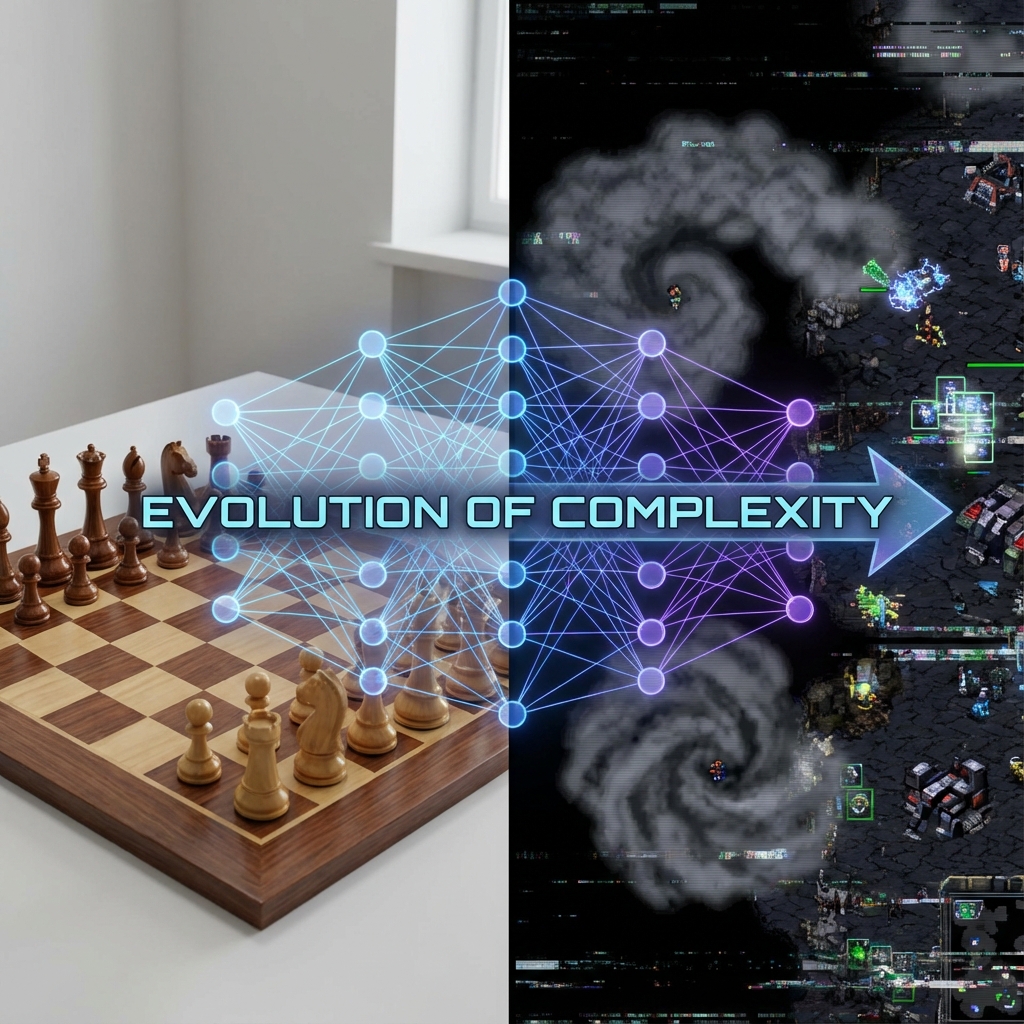
From Order to Chaos: Moving from the perfect information of chess to the 'fog of war' in Starcraft required AI to master long-term planning under uncertainty.
The Pivot to Reality: Biology as a Game
Winning games was never the endgame. The "Manhattan Project" style gathering of talent at DeepMind had a singular purpose: to apply these general learning systems to scientific problems that had stumped humanity for decades.
The Protein Folding Problem was the perfect candidate. Proteins are the machinery of life, and their function is determined by their 3D shape. Predicting this shape from a 1D string of amino acids is a physics problem of mind-boggling complexity. For 50 years, biology had struggled to predict these structures experimentally, a slow and expensive process.
DeepMind treated biology as a game. The "score" was the accuracy of the atomic coordinates; the "environment" was the laws of physics and the history of known protein structures.
In 2020, AlphaFold entered the CASP (Critical Assessment of Structure Prediction) competition and achieved a median score of 92.4 GDT, effectively solving the problem for single proteins . It was a moment where the digital world reached out and touched the physical one. The release of the AlphaFold database, containing predicted structures for nearly all known proteins (200 million+), has been described as a "gift to humanity," accelerating drug discovery and our understanding of disease .
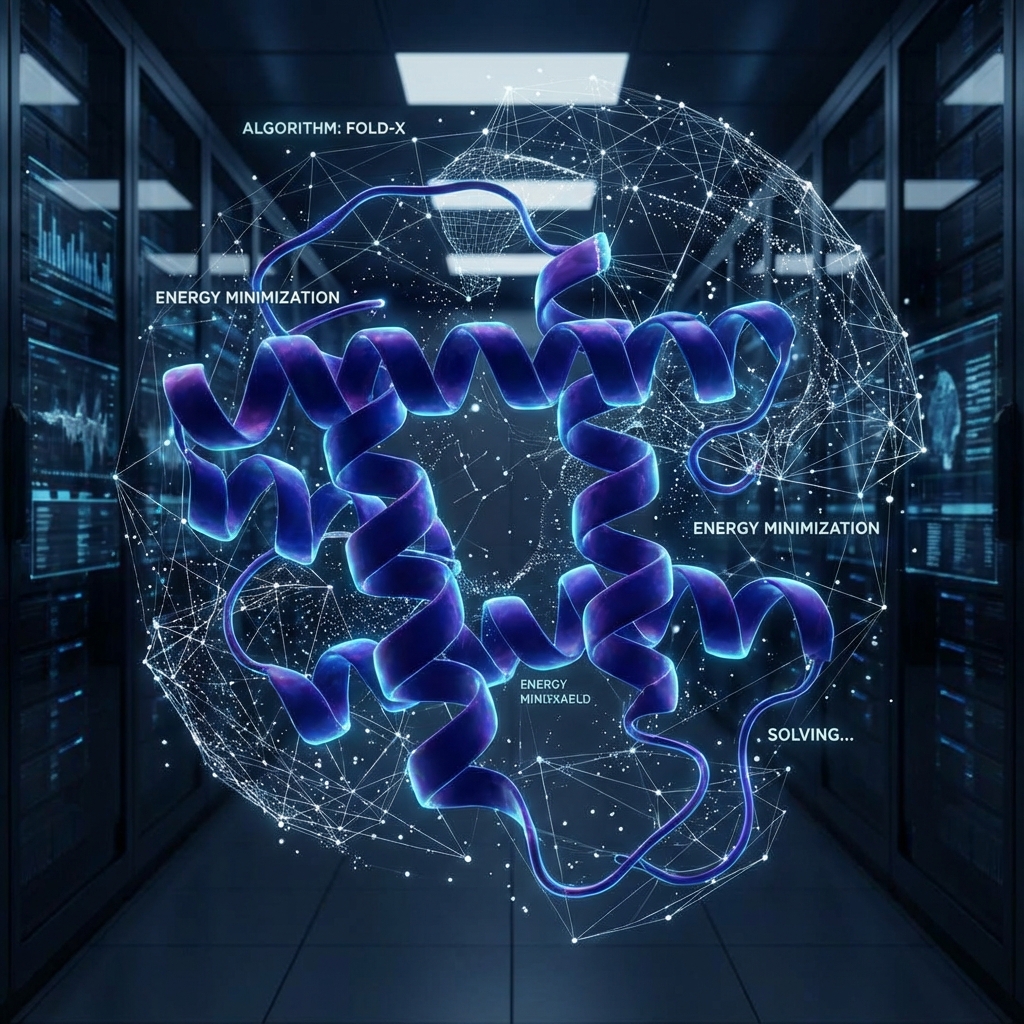
The Digital Biology Revolution: AlphaFold treated the laws of physics as a game rule set, predicting 3D structures from 1D sequences with experimental accuracy.
The Geopolitical Blast Radius
The ripples of these advancements were not confined to the laboratory. The victory of AlphaGo over Lee Sedol (and later the Chinese champion Ke Jie) had a profound geopolitical impact, particularly in China.
Just as the launch of Sputnik in 1957 shocked the United States into the Space Race, AlphaGo served as a "Sputnik moment" for China. It shattered the assumption that AI was a distant sci-fi dream. In July 2017, less than two months after Ke Jie's defeat, China released its "New Generation Artificial Intelligence Development Plan," setting a national goal to become the world leader in AI by 2030 .
This marked the beginning of the modern AI arms race. Governments realized that AGI is not just a scientific curiosity but a strategic asset comparable to nuclear capability. The technology that can solve protein folding can also, theoretically, design bio-weapons or autonomous cyber-warfare agents.
The Horizon: Safety and the Oppenheimer Shadow
The documentary and the broader discourse around DeepMind are haunted by the specter of Robert Oppenheimer. The comparison is explicit: a group of brilliant scientists gathering in secret to unleash a force of nature that they may not be able to control.
Demis Hassabis and his team have frequently emphasized that the "move fast and break things" ethos of Silicon Valley is dangerous when applied to AGI. You cannot "patch" a superintelligence after it has gone rogue. This has led to a focus on AI Safety and alignment—ensuring that the system's goals remain compatible with human flourishing.
As we stand on the precipice of AGI, the duality of the technology is stark. On one side, we have the promise of AlphaFold: curing diseases, solving climate change, and decoding the universe. On the other, we have the risk of unaligned power and the destabilization of global order. The journey that began with a pixelated paddle hitting a square ball has brought us to the most consequential threshold in human history.

The Oppenheimer Dilemma: The creators of AGI face the dual burden of scientific exhilaration and existential responsibility.
I take on a small number of AI insights projects (think product or market research) each quarter. If you are working on something meaningful, lets talk. Subscribe or comment if this added value.
Appendices
Glossary
- Reinforcement Learning (RL): A type of machine learning where an agent learns to make decisions by performing actions in an environment and receiving rewards or penalties, rather than being explicitly programmed with rules.
- Tabula Rasa: Latin for 'blank slate.' In AI, it refers to a system (like AlphaZero) that learns without any pre-existing human knowledge or data, relying solely on the rules of the system and self-play.
- Imperfect Information Game: A game (like Poker or Starcraft) where players do not have access to all information about the game state (e.g., the opponent's hand or location), contrasting with 'perfect information' games like Chess or Go.
- CASP (Critical Assessment of Structure Prediction): A biennial community-wide experiment (often called the 'Olympics of protein folding') to assess the state of the art in modeling protein structures from amino acid sequences.
Contrarian Views
- While AlphaFold is a breakthrough, some biologists argue it hasn't 'solved' protein folding in the dynamic sense; it predicts static crystal structures but struggles with how proteins move and interact in real-time (though AlphaFold 3 addresses some of this).
- Critics of the 'AGI is imminent' narrative argue that success in closed systems (games) does not necessarily translate to the open-ended, undefined complexity of the real world (the 'moravec's paradox' aspect).
- The 'Sputnik moment' narrative is sometimes viewed as mutually reinforced hype by both US tech companies (seeking funding/regulation capture) and Chinese officials (seeking internal budget justification).
Limitations
- The article focuses on the DeepMind narrative and does not extensively cover competitor achievements (e.g., OpenAI's Dota 2 bot) which paralleled some of these developments.
- The definition of 'solved' regarding protein folding is nuanced; while AlphaFold achieved experimental accuracy for single chains, the biological reality of protein complexes and dynamics is far more intricate.
Further Reading
- AlphaFold 3 Technical Blog - https://blog.google/technology/ai/google-deepmind-isomorphic-alphafold-3-ai-model/
- The AI Revolution: The Road to Superintelligence (Wait But Why) - https://waitbutwhy.com/2015/01/artificial-intelligence-revolution-1.html
References
- AlphaGo - The Movie - DeepMind (YouTube) (video, 2017-01-01) https://www.youtube.com/watch?v=WXuK6dek9_M -> Primary source for the Move 37 probability (1 in 10,000) and the narrative of the Lee Sedol match.
- Mastering Chess and Shogi by Self-Play with a General Reinforcement Learning Algorithm - arXiv (journal, 2017-12-05) https://arxiv.org/abs/1712.01815 -> The foundational paper for AlphaZero, detailing the tabula rasa approach and its performance against Stockfish and AlphaGo.
- Grandmaster level in StarCraft II using multi-agent reinforcement learning - Nature (journal, 2019-10-30) https://www.nature.com/articles/s41586-019-1724-z -> Describes AlphaStar's architecture, the handling of imperfect information, and the constraints applied to ensure fair play against humans.
- Highly accurate protein structure prediction with AlphaFold - Nature (journal, 2021-07-15) https://www.nature.com/articles/s41586-021-03819-2 -> The seminal paper confirming AlphaFold 2's performance at CASP14 and its solution to the protein folding problem.
- AlphaFold: The AI Breakthrough Redefining Medicine and Drug Discovery - Atomic Academia (journal, 2024-12-30) https://atomicacademia.com/alphafold-review-2024/ -> Provides recent context on the impact of AlphaFold on drug discovery and its limitations as of 2024.
- China's New Generation of Artificial Intelligence Development Plan - Foundation for Law and International Affairs (gov, 2017-07-30) https://flia.org/notice-state-council-issuing-new-generation-artificial-intelligence-development-plan/ -> The official translation of China's 2017 AI strategy, confirming the timeline post-AlphaGo.
- AlphaFold 3 predicts the structure and interactions of all of life's molecules - Google DeepMind (org, 2024-05-08) https://blog.google/technology/ai/google-deepmind-isomorphic-alphafold-3-ai-model/ -> Details the latest iteration (AlphaFold 3) extending capabilities to DNA/RNA, showing the continued evolution beyond the transcript's timeline.
- Will a Chinese 'Sputnik moment' in AI Unleash Dynamism in the West? - The Globalist (news, 2018-08-26) https://www.theglobalist.com/artificial-intelligence-china-united-states-technology-economy/ -> Analyzes the 'Sputnik moment' concept regarding AlphaGo and China's subsequent policy shifts.
- AlphaGo's Move 37 and Its Implications for AI-Supported Military Decision-Making - ResearchGate (journal, 2024-04-10) https://www.researchgate.net/publication/379900000_AlphaGo's_Move_37_and_Its_Implications_for_AI-Supported_Military_Decision-Making -> Connects the creativity of Move 37 to broader implications in high-stakes decision making.
- The unexpected difficulty of comparing AlphaStar to humans - AI Impacts (org, 2019-09-17) https://aiimpacts.org/the-unexpected-difficulty-of-comparing-alphastar-to-humans/ -> Discusses the nuances of APM limits and the 'fairness' of AlphaStar's victory, adding necessary skepticism.
Recommended Resources
- Signal and Intent: A publication that decodes the timeless human intent behind today's technological signal.
- Thesis Strategies: Strategic research excellence — delivering consulting-grade qualitative synthesis for M&A and due diligence at AI speed.
- Blue Lens Research: AI-powered patient research platform for healthcare, ensuring compliance and deep, actionable insights.
- Lean Signal: Customer insights at startup speed — validating product-market fit with rapid, AI-powered qualitative research.
- Qualz.ai: Transforming qualitative research with an AI co-pilot designed to streamline data collection and analysis.