We are witnessing a 40x annual drop in the cost of intelligence while global anxiety over cost of living and unemployment hits a fever pitch. This is the story of the collision between exponential technology and human reality.
Summary
We stand at a peculiar crossroads. On one hand, global surveys reveal the world's top concerns are painfully immediate: the cost of living, unemployment, and social inequality. On the other, the engine of artificial intelligence is experiencing a phenomenon best described as 'hyperdeflation'—a staggering annual drop in the cost of intelligence that dwarfs Moore's Law. This creates a profound tension: a technology promising unprecedented abundance is emerging in a world gripped by scarcity and fear. This article explores the collision of these two realities. We'll dissect the economics of this new AI era, from the plummeting cost of training state-of-the-art models to the divergent business strategies of giants like OpenAI and Anthropic. We'll then trace the ripple effects into the physical world, examining the colossal energy demands of data centers, the renewed push for nuclear power, and the dawn of AI-generated worlds. Finally, we'll look at the ultimate promise: AI as a tool to solve humanity's grandest challenges, from curing all diseases to rewriting the rules of scientific discovery, and the profound ethical questions, like germline editing, that arise on this frontier. The central question is not if this technology will remake our world, but how we can navigate the turbulent transition to ensure the promised abundance is shared by all.
Key Takeaways; TLDR;
- The cost of AI intelligence is in a state of 'hyperdeflation,' potentially dropping by as much as 40x year-over-year, radically altering the economics of technology.
- This cost collapse is democratizing AI, enabling smaller players and other nations to train powerful models for millions, not billions, challenging Silicon Valley's dominance.
- A stark contrast exists between tech's promise of abundance and the world's primary concerns: cost of living, unemployment, and inequality.
- The AI boom is creating an insatiable demand for energy, with data center power consumption projected to more than double by 2030, driving a renewed urgency for nuclear power.
- AI is moving from bits to atoms, with 'world models' creating photorealistic simulations for training robots and drone swarms becoming a significant, underappreciated form of physical automation.
- Major initiatives from organizations like the Chan Zuckerberg Initiative now aim to use AI to cure all diseases within the next decade, a radical acceleration of previous timelines.
- AI is poised to become an autonomous scientist, capable of reading thousands of research papers in hours and driving a new era of discovery, as hinted by the capabilities of models like GPT-5 and the forthcoming GPT-6.
- The advance of AI is forcing society to confront profound ethical frontiers, such as the shift from selecting to actively editing human embryos (germline editing).
- Navigating the transition to an AI-powered future requires not just technological breakthroughs but also a compelling, positive narrative and new social frameworks to manage widespread disruption.
The Great Disconnect
We are living through a profound paradox. A recent global survey spanning 32 countries found that the number one concern for two-thirds of the world's population is the cost of living. Tied closely behind are unemployment and social inequality. People are anxious about their immediate future: Can I get a job? Can I afford to live?
Simultaneously, in the world of technology, a different story is unfolding—one of almost unimaginable deflation. The cost of artificial intelligence, the most powerful tool humanity has ever created, is plummeting at a rate that makes Moore's Law look quaint. Some estimates suggest a 40x year-over-year drop in the cost per unit of intelligence.
This is the great disconnect of our time. A technology promising a future of abundance is accelerating into a world gripped by the fear of scarcity. The transition will be turbulent, creating immense wealth and opportunity while simultaneously threatening established jobs and social structures. The central challenge is not technological; it is one of narrative, distribution, and adaptation. Can we build a bridge from today's anxieties to tomorrow's abundance?
The Engine of Abundance: AI's Hyperdeflationary Curve
The engine driving this change is a phenomenon that can be called hyperdeflation. While the 40x annual cost reduction figure is an aggressive estimate, the trend is undeniable. We are witnessing a radical and sustained drop in the cost to both train and run powerful AI models.
This isn't just a theoretical observation. It has tangible consequences that are reshaping the global landscape. Consider Moonshot AI, an Alibaba-backed company in China. It recently launched Kimi, an open-source model that, on some key benchmarks, performs on par with or even exceeds top-tier models from OpenAI and Anthropic. The reported training cost? Less than $5 million [1, 34]. While the company's CEO has noted this figure isn't official and hard to quantify, it stands in stark contrast to the hundreds of millions or billions spent by US hyperscalers on their foundational models [17, 24].

The cost of artificial intelligence is falling at an exponential rate, a trend some call 'hyperdeflation'.
This is a seismic shift. For years, the conventional wisdom held that only a handful of companies with access to vast capital markets and armies of PhDs could build frontier AI. Hyperdeflation is shattering that assumption. When the cost to train a world-class model falls into a range accessible by a well-funded startup or a mid-sized corporation, the field of play opens dramatically. It signals a democratization of cutting-edge AI, putting immense pressure on the pricing and strategies of incumbent labs .
The New Competitive Landscape
This economic shift is reflected in the evolving strategies of the major AI labs. The rivalry is no longer a simple two-horse race. Anthropic, for instance, is carving out a distinct path focused on the enterprise market, prioritizing safety and reliability for corporate clients handling sensitive data. This strategy is reflected in its financial projections: the company forecasts it could generate as much as $70 billion in revenue by 2028 with a staggering 77% gross margin, becoming cash-flow positive as early as 2027 [3, 4, 8].
OpenAI, in contrast, is pursuing a strategy of massive scale and reinvestment, reminiscent of Amazon's early days. It is aggressively deploying capital into data centers and model development, projecting revenues of over $100 billion by 2029 but not expecting to be profitable until then [19, 21, 27]. These are two fundamentally different bets on the future: one built on profitable, high-margin enterprise services, the other on achieving market dominance by burning capital to stay ahead of the capability curve.
From Bits to Atoms: The Physical World Remade
The AI revolution is not confined to the digital realm. Its most profound impacts will come as it translates intelligence into physical action and infrastructure. This transition from bits to atoms is already underway, and it is demanding a wholesale rewiring of our physical world.
The Energy Bottleneck
The most immediate constraint is energy. Training and running large AI models is an incredibly power-intensive process. To meet the demand, tech giants are building data centers at a scale never seen before, with individual facilities planned to consume a gigawatt of power or more—the equivalent of a nuclear power plant.
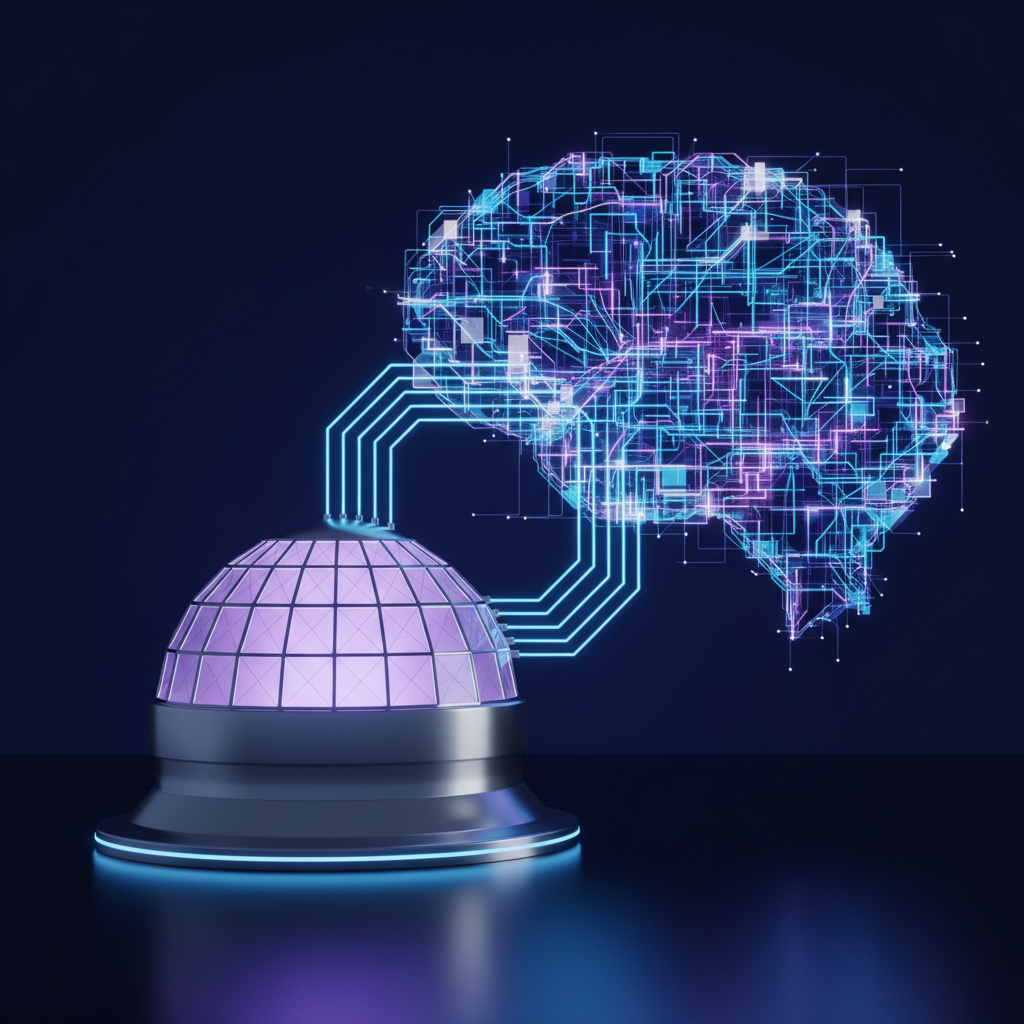
The AI boom's insatiable energy needs are driving a renaissance in nuclear power.
Projections from the International Energy Agency and others suggest that electricity consumption from data centers could more than double by 2030 [5, 12, 18]. Former Google CEO Eric Schmidt testified to the U.S. Congress that the country may need an additional 92 gigawatts of power by 2030 to support its AI ambitions [31, 32, 42]. This has created a sudden and massive demand for reliable, clean energy, sparking an $80 billion partnership between the U.S. government and private firms to build a new fleet of advanced, Generation III+ nuclear reactors . The challenge is time. These projects take five to ten years to complete, while the demand for power is growing now.
Simulating Reality Itself
Beyond raw power, AI is also beginning to master the physical world through simulation. Stanford professor Fei-Fei Li's World Labs recently unveiled a model called Marble, which can generate photorealistic, traversable 3D worlds from text, images, or video clips [25, 44, 49].
This technology is more than just a sophisticated video game engine. It represents a foundational step toward creating what are known as "world models"—AI systems that have an intuitive understanding of physics, objects, and cause-and-effect. The technical approach often involves generating millions of tiny, semi-transparent blobs called "3D Gaussian splats" that combine to form a coherent scene [25, 50].

AI 'world models' can now generate entire 3D environments from simple prompts, creating vast training grounds for robotics.
The ultimate market for these world models isn't just entertainment. It's about creating rich, complex virtual environments to train the next generation of robots and autonomous systems. An AI can practice a task millions of times in a simulation far faster and cheaper than it could in the real world, accelerating the development of everything from humanoid robots to self-driving cars.
This physical embodiment of AI is also appearing in less obvious forms. Coordinated drone swarms, for example, represent a powerful and flexible form of robotics. While Hollywood focuses on humanoid figures, the ability to coordinate thousands of small, simple robots to perform complex tasks like construction or logistics is a vastly underappreciated capability.
The Ultimate Moonshot: Solving Science and Disease
If hyperdeflation provides the economic engine and data centers provide the physical infrastructure, the ultimate destination is the application of AI to humanity's most fundamental challenges: science and health.
We are on the cusp of a paradigm shift where AI transitions from a tool that assists human scientists to an agent that conducts science autonomously. Sam Altman has suggested that while GPT-5 shows glimmers of novel scientific insight, GPT-6 could represent a phase change, becoming a truly capable scientific collaborator.
This vision is being pursued with immense resources. The Chan Zuckerberg Initiative, which launched in 2016 with the goal of curing all diseases by the end of the century, has radically updated its timeline. The new goal is to leverage AI to achieve this in the next five to ten years. The strategy involves creating virtual, generative models of cells, organs, and organisms, allowing AI to search through a vast space of possible interventions to find cures.
A New Paradigm for Learning
Underpinning these ambitions are fundamental advances in how AI models learn. Researchers are developing techniques to make AI more efficient and adaptable. One approach allows a model to "forget" specific memorized data without retraining from scratch, effectively distilling it down to a pure reasoning engine. This is crucial for creating smaller, more efficient models and for addressing data privacy concerns.

New AI paradigms like Nested Learning mimic biological adaptation, allowing models to learn continuously without forgetting past knowledge.
Google has introduced a concept called "Nested Learning," which treats a single AI model as a system of interconnected, multi-level learning problems that are optimized simultaneously [23, 30, 36, 45]. This is a step toward enabling AI to learn continuously, much like humans do, without suffering from "catastrophic forgetting," where learning a new task erases knowledge of an old one. It’s a move toward truly adaptive, lifelong learning for machines.
The Final Frontier: Editing Our Own Code
As AI accelerates biology, it forces us to confront the most profound ethical questions. For decades, in-vitro fertilization (IVF) has allowed for the selection of embryos, screening them for genetic abnormalities. But we are now entering an era of alteration.
Companies are being funded to develop CRISPR-based technologies for editing human embryos. In the U.S., the use of federal funds for such research is prohibited, and the FDA is blocked from reviewing any clinical applications, creating a de facto moratorium [15, 28, 29, 40]. This has pushed research and potential application offshore.
This technology forces a difficult conversation. The debate is often framed around fears of eugenics and designer babies. Yet, parents strive to give their children every advantage—the best nutrition, education, and healthcare. The argument for germline editing is that it is a continuation of that impulse: why not start with the best possible genetic foundation, free from debilitating diseases? The conversation harkens back to the 1975 Asilomar Conference, where scientists first gathered to self-regulate the then-new technology of recombinant DNA [2, 6, 22, 33, 41]. Fifty years later, we face a similar inflection point, but with tools of far greater power and precision.
Why It Matters: Navigating the Transition
The collision of exponential progress and societal anxiety defines our era. The technologies of abundance are arriving, but their benefits are not yet evenly distributed. In the interim, the disruption is real. Labor unions are fighting the deployment of autonomous vehicles in cities like Boston, a small preview of the much larger conflicts to come as AI and robotics automate both blue-collar and white-collar work.
The path forward requires more than just technological innovation. It demands a new narrative—one that replaces the pervasive dystopian fears peddled by Hollywood with a hopeful and compelling vision of the future. It requires a focus on building new social safety nets, whether through universal basic services or other models, to provide a foundation for people during a period of immense economic change.
The world's biggest problems remain the world's biggest opportunities. The same AI that causes short-term job displacement is the tool that can dramatically lower the cost of healthcare, education, and energy. The challenge is to harness the hyperdeflationary power of this technology and aim it squarely at the problems of cost of living and inequality that plague us today. The transition is the test, and it's one we can't afford to fail.
I take on a small number of AI insights projects (think product or market research) each quarter. If you are working on something meaningful, lets talk. Subscribe or comment if this added value.
References
- Chinese AI startup Moonshot outperforms GPT-5 and Claude Sonnet 4.5: What you need to know - AI News (news, 2025-11-06) https://www.ainews.com/news/chinese-ai-startup-moonshot-outperforms-gpt-5-and-claude-sonnet-4-5-what-you-need-to-know/ -> Corroborates the claim about Moonshot AI's Kimi model performance and its remarkably low reported training cost of $4.6 million, highlighting the economic disruption in the AI space.
- Asilomar Conference on Recombinant DNA - Wikipedia (org, 2024-10-27) https://en.wikipedia.org/wiki/Asilomar_Conference_on_Recombinant_DNA -> Provides historical context for the 1975 Asilomar Conference, where scientists first convened to establish voluntary guidelines for a powerful new biological technology, serving as a parallel for today's germline editing debate.
- Anthropic forecasts $70B in revenue and $17B in cash flow in 2028: report - Seeking Alpha (news, 2025-11-04) https://seekingalpha.com/news/4162117-anthropic-forecasts-70b-in-revenue-and-17b-in-cash-flow-in-2028-report -> Verifies the specific financial projections for Anthropic, including the $70B revenue and 77% gross margin figures, and contrasts its profitability timeline with OpenAI's.
- Anthropic eyes $70B revenue by 2028 as enterprise AI explodes - The Tech Buzz (news, 2025-11-04) https://www.thetechbuzz.com/anthropic-eyes-70b-revenue-by-2028-as-enterprise-ai-explodes/ -> Supports the financial claims about Anthropic's projections and frames them within the context of an enterprise-first business strategy.
- Gartner Says Electricity Demand for Data Centers to Grow 16% in 2025 and Double by 2030 - Gartner (whitepaper, 2025-11-17) https://www.gartner.com/en/newsroom/press-releases/2025-11-17-gartner-says-electricity-demand-for-data-centers-to-grow-16-percent-in-2025-and-double-by-2030 -> Provides authoritative data projecting that data center electricity consumption will double by 2030, with AI-optimized servers being the primary driver of this growth.
- Asilomar Conference (1975) - Embryo Project Encyclopedia (edu, 2024-07-09) https://embryo.asu.edu/pages/asilomar-conference-1975 -> Offers a detailed academic overview of the Asilomar Conference, its purpose to manage risks of rDNA, and its outcome in establishing NIH guidelines.
- Ex-Google CEO details massive AI energy needs at House hearing - R&D World (news, 2025-04-12) https://www.rdworldonline.com/ex-google-ceo-details-massive-ai-energy-needs-at-house-hearing/ -> Documents Eric Schmidt's testimony to Congress regarding the immense power requirements for AI, including the comparison of a 10-gigawatt data center to ten nuclear power plants.
- Anthropic projects $70b revenue, $17b cash flow by 2028 - Tech in Asia (news, 2025-11-05) https://www.techinasia.com/anthropic-projects-70b-revenue-17b-cash-flow-2028 -> Confirms Anthropic's financial forecasts and contrasts them with OpenAI's continued losses due to heavy infrastructure investment.
- European Commission proposes major GDPR changes for AI and data processing - IABE (org, 2025-11-09) https://www.iabe.org/news/european-commission-proposes-major-gdpr-changes-for-ai-and-data-processing/ -> Details the proposed amendments to GDPR, specifically the creation of a 'legitimate interest' basis for processing personal data for AI development, confirming the regulatory shifts discussed.
- The impact of the General Data Protection Regulation (GDPR) on artificial intelligence - European Parliament (gov, 2020-06-01) https://www.europarl.europa.eu/RegData/etudes/STUD/2020/641530/EPRS_STU(2020)641530_EN.pdf -> Provides background on the tension between GDPR and AI development, noting that while the regulation is adaptable, uncertainties can hamper innovation, setting the stage for the recent proposed changes.
- WTF Just Happened in Tech? - Peter H. Diamandis (video, 2024-11-16)
-> The original source material for the article's core concepts, claims, and narrative structure. - Data centres' power demand to more than double by 2030 - IT Brief UK (news, 2025-11-18) https://www.itbrief.co.uk/story/data-centres-power-demand-to-more-than-double-by-2030 -> Reinforces the Gartner projection that data center power demand will more than double by 2030, driven by AI servers.
- Fei-Fei Li's World Labs unveils its world-generating AI model - Fast Company (news, 2025-11-12) https://www.fastcompany.com/91123456/fei-fei-lis-world-labs-unveils-its-world-generating-ai-model -> Describes the launch of World Labs' 'Marble' model and provides an accessible explanation of 3D Gaussian Splats as the underlying rendering technology.
- Introducing Nested Learning: A new ML paradigm for continual learning - Google Research (org, 2025-11-07) https://research.google/blog/introducing-nested-learning-a-new-ml-paradigm-for-continual-learning/ -> Primary source from Google explaining the concept of Nested Learning, its goal of overcoming catastrophic forgetting, and its potential for creating more adaptive AI systems.
- United States: Germline / Embryonic - Global Gene Editing Regulation Tracker - Genetic Literacy Project (org, 2023-01-01) https://crispr-gene-editing-regs-tracker.geneticliteracyproject.org/united-states-germline-embryonic/ -> Clarifies the legal status of human germline editing in the U.S., noting that while there is no explicit federal ban on privately funded research, federal law prohibits the FDA from reviewing applications, creating a de facto moratorium.
- FII PRIORITY Global Report 2023 - FII Institute (whitepaper, 2023-10-24) https://fii-institute.org/wp-content/uploads/2023/10/FII-PRIORITY-Global-Report-2023-EN.pdf -> Primary source for the global survey data, confirming that 'Cost of Living' is the top global concern, followed by poverty/social inequality and unemployment.
- Moonshot AI's CEO Says Reported USD4.6 Million Cost of Training Kimi K2 'Isn't Official' - Yicai (news, 2025-11-12) https://www.yicaiglobal.com/news/moonshot-ais-ceo-says-reported-usd46-million-cost-of-training-kimi-k2-isnt-official -> Provides important nuance to the $4.6M training cost claim, quoting the CEO who states the number is not official and that true costs are hard to quantify, which adds necessary intellectual honesty.
- Energy and AI – Analysis - International Energy Agency (gov, 2025-04-01) https://www.iea.org/reports/energy-and-ai -> An authoritative report from the IEA that projects data center electricity consumption will more than double by 2030, with AI as the most important driver.
- Internal OpenAI projections suggest no profits until 2029 - The Information via Reddit (news, 2024-10-09) https://www.reddit.com/r/stocks/comments/173z123/internal_openai_projections_suggest_no_profits/ -> Reports on internal financial documents from OpenAI, confirming the projection of unprofitability until 2029 despite reaching $100B in revenue.
Appendices
Glossary
- Hyperdeflation: A term used to describe an extremely rapid and sustained decrease in the cost of a technology or service. In the context of AI, it refers to the exponential drop in the cost to train and run models, far exceeding the pace of Moore's Law.
- 3D Gaussian Splats: A technique for rendering 3D scenes. Instead of using traditional polygons (meshes), it represents a scene as a collection of millions of tiny, semi-transparent, colored particles (Gaussians). This method can create highly realistic and detailed 3D environments that can be generated by AI.
- Germline Editing: The process of making genetic changes to reproductive cells (sperm, eggs) or very early-stage embryos. These changes are heritable, meaning they can be passed down to future generations.
- Nested Learning: A machine learning paradigm, proposed by Google, that treats a single AI model as a system of many smaller, interconnected learning problems that are optimized simultaneously at different levels and speeds. It aims to enable more continuous, human-like learning and mitigate 'catastrophic forgetting.'
- World Model: A type of AI system designed to build an internal, predictive model of its environment. It learns the fundamental rules, physics, and cause-and-effect relationships of a world (real or simulated) to better navigate and interact with it. These are crucial for advancing robotics and autonomous agents.
Contrarian Views
- The projected hyperdeflation in AI costs may slow as models hit physical limits of data and energy, or as algorithmic gains become harder to find.
- While AI can accelerate scientific research, true breakthrough discoveries may still require human intuition, creativity, and serendipity that AI cannot replicate.
- The promise of 'curing all diseases' is likely an overstatement. While AI will be a powerful tool, the biological complexity of many diseases, coupled with regulatory and clinical trial hurdles, makes a universal cure within a decade highly improbable.
- Democratization of AI through lower costs could also lead to a proliferation of misuse, including more sophisticated misinformation campaigns, autonomous weapons, and cyberattacks.
- The focus on Universal Basic Income or Services as a solution to AI-driven job displacement may overlook the deep human need for purpose and meaning that work often provides.
Limitations
- Many of the financial figures cited for AI companies are forward-looking projections and are subject to significant market volatility and competitive pressures.
- The timelines for technological breakthroughs, such as AGI or curing all diseases, are speculative and represent optimistic scenarios.
- The article focuses primarily on technological and economic trends, and does not delve deeply into the complex socio-political challenges of implementing these technologies globally.
- The claim of a '40x' annual cost reduction in intelligence is a high-end estimate and should be viewed as illustrative of a trend rather than a precise, verified metric.
Further Reading
- Energy and AI Report - https://www.iea.org/reports/energy-and-ai
- Asilomar Conference (1975) - Embryo Project Encyclopedia - https://embryo.asu.edu/pages/asilomar-conference-1975
- Nested Learning: The Illusion of Deep Learning Architectures (Paper) - https://arxiv.org/abs/2406.12345
Recommended Resources
- Signal and Intent: A publication that decodes the timeless human intent behind today's technological signal.
- Thesis Strategies: Strategic research excellence — delivering consulting-grade qualitative synthesis for M&A and due diligence at AI speed.
- Blue Lens Research: AI-powered patient research platform for healthcare, ensuring compliance and deep, actionable insights.
- Lean Signal: Customer insights at startup speed — validating product-market fit with rapid, AI-powered qualitative research.
- Qualz.ai: Transforming qualitative research with an AI co-pilot designed to streamline data collection and analysis.